When Local LLMs Beat Cloud APIs (and When They Don’t)
When Local LLMs Beat Cloud APIs (and When They Don’t)
Every technical founder eventually hits the same fork: call a hosted model API, or run something you control — on your VPC, on-prem, or on a dedicated box you can actually name.
Cloud APIs won the last few years for good reasons: quality, speed of iteration, and almost no MLOps. Local and self-hosted LLMs win for other reasons: data residency, predictable unit economics at high volume, air-gapped constraints, and not shipping sensitive text to a third party by default.
We ship both patterns from CodeMyPixel — agentic AI and custom SaaS for US/EU buyers, including document and ops-heavy products such as TextGPT / IQR.Codes, LexClaro, and IoT-adjacent flows like BAX IoT. This article is a decision matrix, not a manifesto. Local is not “more serious.” Cloud is not “less secure” by slogan. Pick for constraints you can write down.
What “local” means in practice
Buyers use “local LLM” for several different things. Separate them early:
- On-device — model on a laptop, phone, or edge gateway
- Self-hosted in your cloud — vLLM / TGI / Ollama-class serving in your account
- Private VPC endpoint from a vendor — still someone else’s weights and control plane, but traffic stays in a private path
- True air-gapped — no outbound calls; updates are a logistics problem
Most “we need local briefs are really (2) or (3). True air-gap is rarer and costlier to operate.
When local (or self-hosted) usually wins
Data sensitivity and contracts
If legal, security, or a customer DPA forbids sending prompts and documents to a public multi-tenant API, the architecture debate is over. You still might use a private hosted endpoint — but you cannot pretend a consumer chat API is fine because “we anonymize.
Healthcare-adjacent and regulated workflows (the class of care we take with builds like VidalSigns) tend to push toward minimization first, then toward controlled inference second. Local does not equal compliant. It can make a compliance story possible.
Latency and locality
If the model sits next to the data and the user is in the same region, you can remove a network hop and some tail latency. For interactive voice or tool-loop agents, that can matter more than peak benchmark scores.
Unit economics at steady high volume
Cloud APIs are wonderful until your monthly token bill becomes a line item that scares finance. Self-hosting shifts cost to GPUs, engineering time, and utilization risk. If you have steady, predictable traffic and can keep GPUs busy, local can win. If traffic is spiky and low, cloud usually wins.
Offline / constrained environments
Factories, clinics, and field kits sometimes cannot depend on the public internet. Edge or on-prem models are then a product requirement, not a preference.
When cloud APIs usually win
You are still finding the product
If prompts, tools, and UX change weekly, paying for tokens is cheaper than re-provisioning GPUs and chasing quantization bugs. Ship on a strong hosted model. Revisit hosting when the workflow stabilizes.
You need frontier quality for hard reasoning
Self-hosted open weights are excellent for many tasks. They are not automatically equal to the best hosted models on every benchmark your product cares about. Run your evals. Do not outsource the decision to a leaderboard screenshot.
Your team cannot staff MLOps
Serving, batching, KV cache behavior, GPU drivers, autoscaling, and model upgrades are real work. A five-to-ten person studio or an early startup — should be honest about whether anyone owns that pager. Cloud APIs buy back focus.
Burst traffic and global users
Hosted providers absorb burst and multi-region better than a single GPU box you forgot to monitor. If your SaaS spikes on launch day, that matters.
Decision matrix
Score each row High / Medium / Low for your product. Lean local/self-hosted when the left column dominates; lean cloud when the right does.
| Factor | Favors local / self-hosted | Favors cloud API |
|---|---|---|
| Data sensitivity | Contractual or regulatory ban on third-party prompts | Standard B2B SaaS data with a solid DPA |
| Traffic shape | Steady, high, predictable | Spiky, low, exploratory |
| Latency needs | Tight interactive loops; co-located data | Tolerant; batch OK |
| Eval burden | Narrow domain; smaller models pass golden set | Hard open-ended tasks; need frontier models |
| Team capacity | Someone owns GPU serving and upgrades | Product engineers only; no MLOps seat |
| Budget shape | CapEx / reserved GPUs acceptable | Prefer OpEx tokens |
| Update cadence | You can schedule model upgrades | You want vendor model improvements immediately |
| Failure mode | Prefer degrade-in-place inside your network | Prefer vendor SLA and multi-region failover |
Rule of thumb we use in scoping: if three or more “favors local” cells are High, design for self-hosted first. If not, start on cloud and keep a portability layer (clean prompts, tool interfaces, eval harness) so you are not trapped.
Architecture choices that keep options open
Regardless of where inference runs, make these boring decisions early:
- Isolate the model behind an internal interface — your app talks to
complete()/tool_loop(), not to a vendor SDK scattered everywhere - Keep prompts and tools in version control — with owners and review
- Build a golden eval set before you optimize cost otherwise you will save money” by silently getting worse
- Log inputs/outputs under a retention policy — local does not remove the need for audit hygiene
- Plan the upgrade path — new weights, new tokenizer quirks, and prompt drift
RAG-heavy products (document QA, contract assist, knowledge ops) fail for retrieval and chunking reasons more often than for “wrong host.” Local vs cloud does not fix a bad corpus pipeline.
Cost honesty (no fake benchmarks)
We will not invent GPU or token prices here — they move fast and depend on region, batching, and model. Force a simple spreadsheet in discovery:
- Expected requests/day and tokens in/out
- Cloud list price at that volume (with cache hits if relevant)
- GPU class needed for your latency target + utilization assumption
- Engineering hours to stand up serving, monitoring, and upgrades
- Cost of being wrong (rework if quality drops)
If nobody will fill rows 4 and 5, you are not ready to self-host.
How we scope local-LLM work
When a founder asks us for “local AI,” we start with constraints, not model names: what data cannot leave the boundary, what golden tasks must pass, who gets the pager, and whether “local” means VPC, on-prem, or edge.
That scoping conversation is where most projects are won or lost. If you want a studio that treats local vs cloud as an engineering decision rather than a buzzword, CodeMyPixel is how we run that discovery for US and EU product teams — alongside custom SaaS and agentic workflows, not as a disconnected ML science project.
Hybrid patterns that work in production
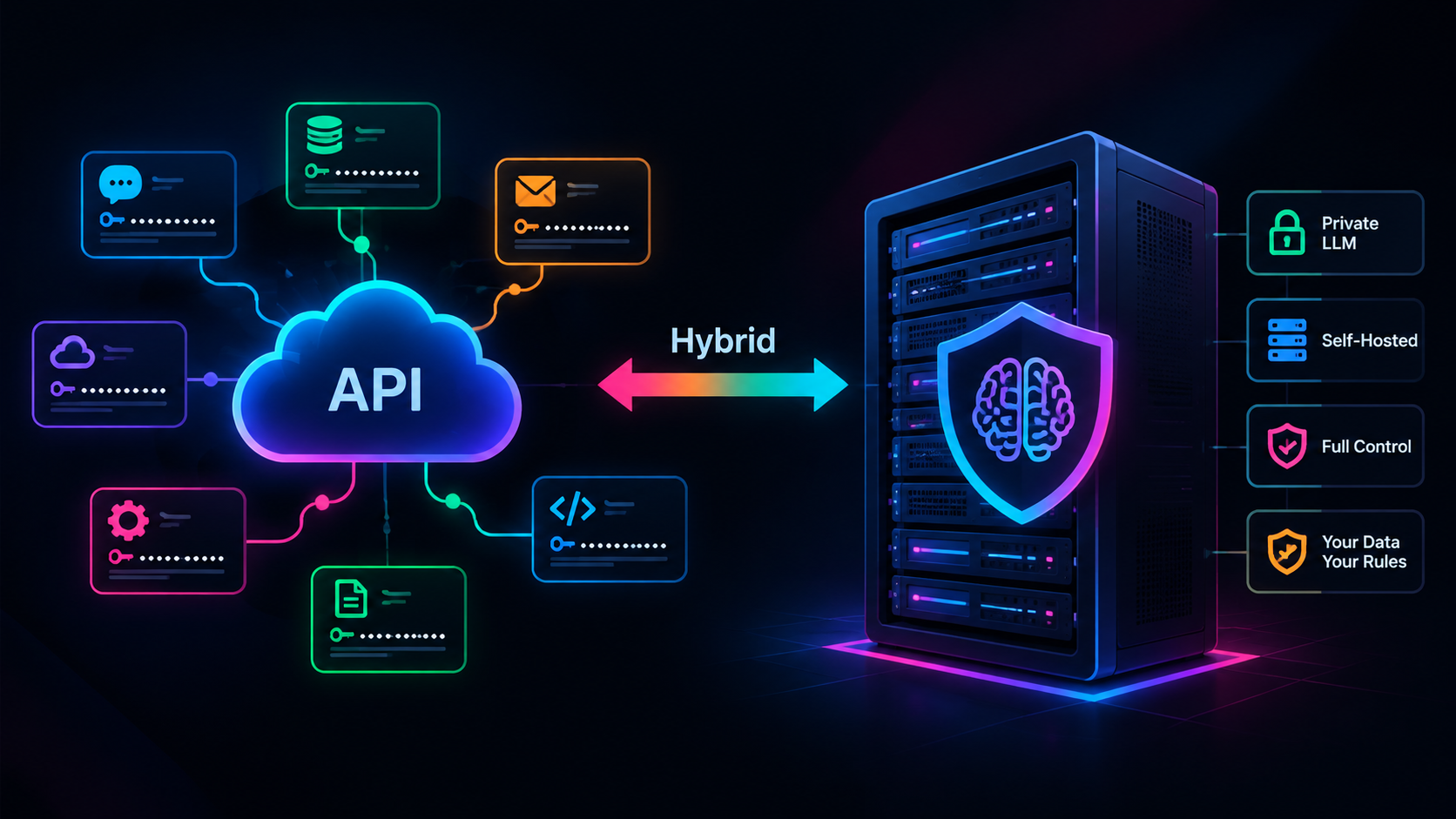
Many serious systems mix approaches: cloud for drafting with local inference for sensitive fields; a small local router plus a large cloud model for hard steps; self-hosted embeddings with cloud generation (or the reverse); private vendor endpoints when you need quality without public multi-tenant traffic.
Hybrid adds complexity. It is still often the correct adult answer.
Closing
Local LLMs win when data boundaries, steady volume, or offline constraints dominate — and you can staff the ops. Cloud wins when you are still finding the product, need frontier quality, or refuse to own GPUs. Write the matrix, run your evals, keep a portability layer, then choose deliberately.
About the author
Johirul Hoq Akash is the founder of CodeMyPixel, a Narayanganj, Bangladesh studio (incorporated 2024; building SaaS since 2020). The team (5–10 people) focuses on agentic AI, local LLMs, custom SaaS, and websites for US/EU clients, with company-stated scale of 100+ products and 50+ clients.